
How to Choose the Right Clearcoat for Your Market
777, 850 or 900? Match your clearcoat to your climate and booth temperature first. This guide compares all three Carswell clearcoats on the same TDS numbers so you can order the right sample.
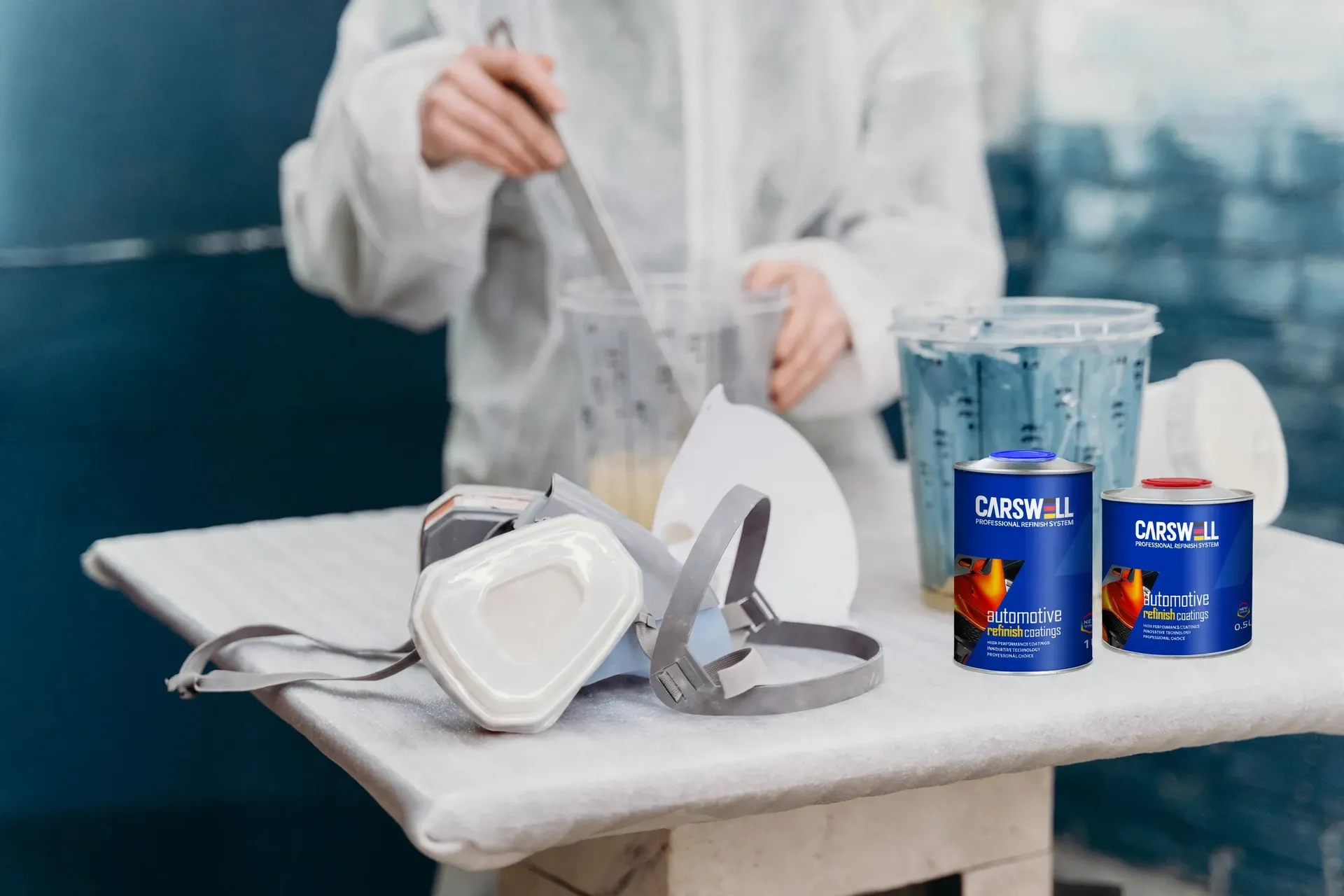
For a hot, high-UV market, start with 900 HS Clear Coat. For the deepest gloss on show-quality work, start with 850 High Gloss Clear Coat. For the easiest clearcoat to spray across a mixed fleet, start with 777 MS Clear Coat. All three share the same drying table, 3-hour pot life at 25°C and 2–3 coats at 40–60 µm, so your choice comes down to climate, gloss and ease of use, not speed. Check your booth temperature before you order — it decides your hardener and thinner — and test a sample in your own booth before committing to a larger order.
This guide suits importers and distributors picking one clearcoat to stock for a region. It does not suit a buyer who needs a certified specification or a guaranteed performance figure — the TDS lists neither, and this guide invents none.
Why does the same clearcoat look great in one shop and fail in another?
Picture your own warehouse in July. A container arrives, your painters mix it the same way they did in March, and by the afternoon the finish does not behave the way it did in spring. The booth is ten degrees hotter, the painter is working faster to keep up, and the clearcoat that flowed smoothly in March now sets before it has levelled.
Nobody changed the product. The season changed the booth, and the booth changed the paint. That is the most common clearcoat mistake an importer can make: you ordered the right brand and the wrong setup for the temperature your painters actually spray in. The TDS for all three Carswell clearcoats is built around four temperature bands — below 18°C, 18–24°C, 25–30°C and above 30°C — because the same can behaves differently in each one. Your first job as a buyer is not to pick a favourite product. It is to find out which band your shops spray in for most of the year, and let that band narrow the choice.
What actually decides whether a clearcoat works in your market?
Three things decide it, and only three: your climate, the gloss your customers expect, and the temperature in the booth on a normal working day.
Climate comes first. The TDS describes 900 HS Clear Coat as having the best durability for harsh and high UV climates, with excellent surface hardness and polishing properties — the only one of the three whose description names a climate. If your market is the Middle East, northern Africa or the high-altitude sun of the Andes, that sentence tells you which product the manufacturer points at when the sun is the problem.
Gloss comes second. The TDS describes 850 as a high performance clear that produces deep gloss and super transparent finishes, and 777 as a high gloss finish with good flow. Both promise gloss, but in different words: 850 promises depth and transparency, 777 promises gloss plus flow. If your shops compete on show-quality finish, the deep gloss wording points to 850. If they compete on fast turnaround with a finish that still looks good, the flow wording points to 777.
Booth temperature comes third, and it is the one buyers most often skip. Every clearcoat here mixes as 100 parts clearcoat to 50 parts hardener, plus thinner, and the hardener and thinner change with the temperature band. Below 18°C you use a Fast hardener and T01 Fast Thinner. Between 18°C and 24°C you use a Standard hardener with T01 or T02. Between 25°C and 30°C you still use a Standard hardener, but with T02 or T03. Above 30°C you switch to a Slow hardener and T03 Slow Thinner. The TDS gives no gloss-meter readings, no UV test numbers and no hardness values, so no comparison here can be settled by a number: the descriptions above are the only evidence the TDS offers. Any supplier quoting a gloss or UV figure for these products is quoting something not in the TDS — ask to see the source.
Which Carswell clearcoat should you choose?
Start with the table — every number comes from the Carswell TDS. Read it from the top down: the bottom rows are identical for all three, so the top three rows are where the choice lives.
| 777 MS Clear Coat | 850 High Gloss Clear Coat | 900 HS Clear Coat | |
|---|---|---|---|
| Designed for | Ease of use; high gloss, good flow, durability, weathering resistance | High performance clear; deep gloss, super transparent finishes | Best coverage and durability for harsh, high UV climates; excellent hardness and polishing |
| Hardener set | 711 Fast / 712 Standard / 713 Slow | 851 Fast / 852 Standard / 853 Slow | 901 Fast / 902 Standard / 903 Slow |
| Thinner parts (per 100 clearcoat : 50 hardener) | 5–10 in every temperature band | 10–25 in every temperature band | 5–10 below 24°C; 10–25 above 25°C |
| Pot life | 3 hrs @ 25°C | same | same |
| Coats and thickness | 2–3 coats, 40–60 µm | same | same |
| Flash-off between coats | 5–10 mins @ 25°C | same | same |
| Dry to polish | 60 mins @ 60°C; 16 hrs @ 25°C | same | same |
| Storage | 24 months @ 20°C, cool and dry place | same | same |
| Packaging | Clearcoat 1L; hardener 0.5L | same | same |
If your market is hot and sunny for most of the year, choose 900 HS Clear Coat, the only description that names harsh and high UV climates. Its hardeners (901 Fast, 902 Standard, 903 Slow) cover below 18°C to above 30°C. Watch the thinner: 5–10 parts below 24°C, 10–25 parts above 25°C — the one place 900 differs from the other two, and your painters need to know it on day one.
If your shops sell on finish quality, choose 850 High Gloss Clear Coat. Its hardeners are 851, 852 and 853, and it takes 10–25 parts of thinner in every band — more than 777 needs. That extra thinner is part of how it flows to a deep gloss, so do not cut the ratio to save thinner.
If your shops handle a mixed fleet and need a forgiving clearcoat, choose 777 MS Clear Coat. The TDS calls it a two-component acrylic polyurethane clearcoat designed for ease of use, and its thinner stays at 5–10 parts in every band, making it the simplest to mix — fewer mistakes, fewer call-backs, one product your painters already know.
Whichever you choose, the working numbers stay the same. All three go on over 1K Basecoat after a tack-cloth wipe, at 2–3 coats and 40–60 µm, with 5–10 minutes of flash-off between coats at 25°C and 15–20 minutes of air-drying before force drying. Guns: gravity 1.2–1.4 mm, siphon 1.3–1.5 mm, conventional 3–4 Bar, RP 2.0–2.5 Bar. Drying is identical too: at 60°C, dust-free 5 minutes, tack-free 15, dry to handle 30, dry to polish 60; at 25°C, dust-free 45 minutes, tack-free 2–3 hours, dry to handle 10 hours, dry to polish 16 hours. If a supplier tells you one of these three dries faster than the others, that claim is not in the TDS: check the table before you pass it on.
Then match your hardener and thinner to the temperature your booth actually reaches, not the weather forecast. A booth in the sun in July can sit above 30°C even when the morning started at 24°C, and above 30°C all three switch to their Slow hardener (713, 853 or 903) with T03 Slow Thinner. Ask your biggest body shop one question this week: what temperature does your booth reach on a normal afternoon? The answer tells you which hardener to stock most of, and it costs nothing to ask.
What should you check before you order?
Check your assumptions first. The drying table assumes a booth that holds 60°C, or a shop that can leave a car 16 hours at 25°C before polishing. If your shops have no oven and polish the next morning, they work on the 25°C column — 16 hours to polish, not 60 minutes. Promise around the column your shops actually use.
Check storage next. All three store for 24 months at 20°C in a cool and dry place. A warehouse that reaches 35°C in summer may not meet that condition, and the TDS gives no storage life for a hot warehouse. Do not assume the 24 months applies at any temperature: if your warehouse runs hot, ask us about storage before you hold a large stock through summer.
Check what is not in the TDS, and do not let anyone fill the gap. No prices, no minimum order quantity, no lead time, no certificate — so this guide quotes and promises none. No case study, no customer efficiency data — so this guide tells no success story. If a quote includes a figure this guide does not contain, treat it as unverified until you see its source.
Finally, set a stop-loss before you order. Test one sample in your own booth, on your own basecoat, with your own painter, at your own afternoon temperature. Spray two or three coats at 40–60 µm, watch the flash-off between coats, and check the finish after the drying time your shop actually uses. If the sample does not behave the way the TDS describes, stop and ask before you order more — a sample costs little, and a container of the wrong setup costs far more. Never commit a full order on a datasheet alone when a sample can settle the question in one afternoon.
What is the fastest safe next step?
Pick the clearcoat that fits your climate from the table, then request a free sample with its matching hardener — 711, 712 or 713 for 777; 851, 852 or 853 for 850; 901, 902 or 903 for 900. Tell us your booth temperature when you ask, so the sample arrives with the right hardener and thinner for your band.
Compare the full TDS data on the product pages: 777 MS Clear Coat, 850 High Gloss Clear Coat, 900 HS Clear Coat. Then send your sample request with your company name, country and booth temperature, and we will confirm the sample and matching hardener before anything ships. You can also reach us directly: tel 0086 750 8980663, WhatsApp 0086 15813763350, email kawelltech@foxmail.com.
FAQ
Which clearcoat is best for hot and sunny countries like the Middle East or Africa?
900 HS Clear Coat. The TDS describes it as having the best durability for harsh and high UV climates, with excellent surface hardness and polishing properties, the only description of the three that names a climate. Its hardeners (901, 902, 903) cover below 18°C to above 30°C.
Can I use the same hardener for 777, 850 and 900 clearcoats?
No. Each clearcoat has its own set, not interchangeable in the TDS: 777 uses 711, 712 and 713; 850 uses 851, 852 and 853; 900 uses 901, 902 and 903 — Fast, Standard and Slow in each set. Always match the hardener to the clearcoat and the temperature band.
How long does a mixed clearcoat stay usable after mixing?
All three have a pot life of 3 hours at 25°C once mixed. The TDS gives no usable life beyond that, so mix only what your painters can spray within those 3 hours.
How long do I have to wait before polishing a car after clearcoat?
It depends on your drying method; the time is the same for all three. At 60°C force drying, dry to polish takes 60 minutes; at 25°C air drying, 16 hours. Dust-free is 5 minutes at 60°C and 45 minutes at 25°C; dry to handle is 30 minutes at 60°C and 10 hours at 25°C.